Inquiry
Form loading...
Honestly, sourcing Tert-Amyl Peroxypivalate 75% safely in 2026 isn't just about finding the lowest price. It's an organic peroxide, so you really do need disciplined supplier screening, documented handling controls, and clear regulatory checks. Before you commit, confirm the product identity, concentration, approved formulation, shelf life, and what industrial application it's actually meant for. Ask the supplier for a current Safety Data Sheet, Certificate of Analysis, batch number, and traceable manufacturing information. The little things matter here. One missing batch record can hold up an entire receiving process.
Reliable sourcing also comes down to practical evidence. Request recent quality documents, verified packaging photos, transport conditions, and emergency contact procedures. Make sure the manufacturer and distributor can actually support compliant storage and temperature-controlled transportation where it's required. Independent audits or recognized certifications can boost confidence, sure—but certificates by themselves aren't enough. Read the actual documents carefully. A slick supplier profile doesn't prove consistent quality.
This guide looks at how to evaluate Tert-Amyl Peroxypivalate suppliers without encouraging unsafe handling or unlawful trade. It covers supplier legitimacy, documentation, packaging integrity, delivery planning, and post-arrival inspection. Buyers should get qualified safety professionals involved and confirm requirements with the relevant authorities before ordering. Assumptions can go wrong. Even experienced procurement teams sometimes miss a changed spec or an outdated SDS. Careful verification, written records, and conservative decisions are still the strongest foundation for responsible sourcing in 2026.

Tert Amyl Peroxypivalate 75% is an organic peroxide formulation used as a free-radical initiator. It helps start polymerization reactions in selected plastics and synthetic resin production. The “75%” describes the formulation strength, not necessarily pure active material. The remaining portion may include a carrier or stabilizing medium. That difference matters during storage, transport, and process design.
Manufacturers value this initiator because it can support polymerization at relatively low temperatures. It is used where controlled reaction timing and consistent molecular weight are important. OECD’s Global Plastics Outlook reports that global plastic production reached 460 million tonnes in 2019. It also states that plastic waste more than doubled from 2000 to 2019. These figures help explain continued demand for reliable polymer-processing chemistry, although demand alone does not prove a product is suitable.
Safety depends on the exact formulation. A professional buyer should request the current safety data sheet, certificate of analysis, active-oxygen value, decomposition information, and storage-temperature limits. The label is not enough. Check lot traceability and packaging condition before acceptance. Small details, such as crystals, leakage, or an unusually warm container, deserve immediate review. ECHA substance information and the UN Recommendations on the Transport of Dangerous Goods provide useful regulatory reference points. In practice, supplier documentation can still be incomplete, so independent technical verification remains necessary.
| Data Dimension | Reliable Data / Practical Guidance | Why It Matters for Safe Sourcing |
|---|---|---|
| Chemical name | Tert-amyl peroxypivalate, commonly abbreviated as TAPP or TAPV. | The exact chemical identity should appear consistently on the quotation, label, SDS, transport documents, and certificate of analysis. |
| CAS Registry Number | CAS RN 29240-17-3 is commonly associated with tert-amyl peroxypivalate. Confirm the CAS number against the current supplier SDS before purchase. | CAS verification helps prevent substitution with a different organic peroxide having different decomposition and transport requirements. |
| Commercial concentration | A “75%” grade generally indicates approximately 75% active organic peroxide in a compatible diluent or formulation medium; the exact balance must be confirmed from the product specification. | The diluent affects active-oxygen content, thermal stability, viscosity, classification, and compatibility with the intended polymerization process. |
| Chemical function | Organic Peroxide Radical Initiator used to generate free radicals during controlled heating. | It is selected according to decomposition rate, polymerization temperature, residence time, and required conversion—not solely by concentration. |
| Main industrial applications | Initiation of free-radical polymerization, including selected acrylic, methacrylic, styrenic, and related resin or plastic processes. | Application suitability depends on the polymer recipe, reaction temperature, pressure, solvent system, and required molecular-weight profile. |
| Hazard classification | Organic peroxide; it may decompose exothermically and can present fire, explosion, and severe eye or skin hazard risks. The legally applicable classification must be taken from the current SDS and label. | Never rely on a generic internet description when preparing a risk assessment, import declaration, warehouse plan, or emergency procedure. |
| Transport information | Organic peroxides are regulated dangerous goods. The UN number, organic-peroxide type, packing method, temperature-control requirements, and transport name must be confirmed from the shipment-specific SDS and applicable modal regulations. | Road, sea, air, and national regulations can differ. A dangerous-goods-capable carrier and compliant packaging are essential. |
| Storage temperature | Store only within the temperature range stated in the current SDS and technical data sheet. Organic peroxide formulations commonly require refrigerated or temperature-controlled storage. | Excess heat can accelerate self-decomposition. A temperature logger, alarmed storage, stock rotation, and documented receiving checks are prudent controls. |
| Storage compatibility | Keep away from heat, sunlight, sparks, flames, reducing agents, strong acids or bases, amines, transition-metal salts, rust, contamination, and incompatible initiators or accelerators. | Contamination or incompatible materials may increase decomposition rate and create a serious thermal-runaway hazard. |
| Packaging and container control | Use the original approved packaging whenever possible. Do not transfer the material to unapproved containers, seal a decomposing product, or return unused material to the original container. | The approved package is part of the safety system and is selected for pressure relief, compatibility, venting, and transport performance. |
| Supplier qualification documents | Request a current SDS, technical data sheet, certificate of analysis, batch number, active-peroxide assay, active-oxygen value where applicable, production date, expiry or retest date, storage requirements, and transport classification. | A complete document package supports regulatory review, incoming-quality control, traceability, and emergency response. |
| 2026 sourcing checks | Verify legal entity details, manufacturing or distribution authorization, dangerous-goods capability, batch traceability, cold-chain capability, recall procedure, insurance, and the validity date of the SDS. | These checks reduce the risk of counterfeit, degraded, mislabelled, improperly transported, or undocumented organic peroxide. |
| Receiving inspection | Check seal integrity, label legibility, container damage, temperature history, batch identity, expiry or retest date, and any signs of swelling, leakage, crystallization, discoloration, or abnormal odor. | Do not open or move a suspicious package unnecessarily. Isolate it and contact trained hazardous-material personnel for instructions. |
| Process-use controls | Use only the validated dosing rate and process window. Control feed rate, reactor temperature, cooling capacity, agitation, pressure relief, and compatibility of equipment materials. | The initiator should be evaluated as part of the complete formulation and process, not as an isolated raw material. |
| Recommended decision rule | Purchase only when identity, concentration, specification, SDS, batch traceability, transport method, storage temperature, and emergency controls are documented and accepted by the responsible EHS and procurement teams. | For organic peroxides, documentation and temperature control are core safety requirements rather than optional purchasing preferences. |
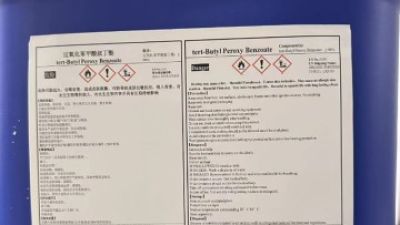
Tert-Butyl Peroxybenzoate (TBPB) 98% is a high-efficiency organic peroxide used to initiate polymerization and crosslinking reactions. In high-pressure ethylene polymerization, it can support both autoclave and tubular processes, helping manufacturers achieve stable reaction performance and consistent polymer quality. Its controlled decomposition characteristics make it suitable for applications that require reliable initiation across demanding processing conditions.
TBPB is also well suited for crosslinking EPDM rubber compounds at ambient temperatures over several weeks. This gradual curing option can benefit manufacturers seeking improved processing flexibility, dependable compound performance, and reduced reliance on elevated-temperature treatment. Proper formulation and handling should be determined according to the specific rubber grade, processing method, and desired curing profile.
When selecting a TBPB supplier, buyers should evaluate assay accuracy, batch-to-batch consistency, packaging integrity, storage guidance, and the availability of a clear certificate of analysis. A qualified China-based manufacturer can provide 98% TBPB with controlled production standards, stable supply capacity, and technical assistance for polymerization and rubber applications. Reliable communication, appropriate shipment conditions, and responsive quality support are also important factors for manufacturers serving diverse markets.
It usually indicates nominal formulation strength, not total purity. Request assay method, tolerance, carrier identity, stabilizer content, and active oxygen value.
Request a current certificate of analysis and safety data sheet. Confirm batch date, lot traceability, transport conditions, and test methods. Missing paperwork matters.
Check the exact chemical identity, concentration, solvent system, and inhibitor details. Similar names may describe different decomposition behavior. Verify before unloading.
Use sealed containers certified for organic peroxide transport. Packaging must suit the formulation and resist impact. Secondary containment can help manage leakage.
Reject damaged, swollen, leaking, or relabeled packages. Photograph the container and isolate it according to approved procedures. Do not improvise.
Follow the supplier’s validated temperature range and current local requirements. Store containers upright in a cool, shaded, ventilated area. Keep them away from heat, sparks, contamination, and incompatible chemicals.
Maintain temperature records, inspection logs, and an emergency response plan. Review packaging suitability annually. Transport conditions or climate may change.
Compare safety evidence before price. Review concentration, transport temperature, packaging details, insurance, delivery lanes, and incident procedures line by line.
Ask for the UN number, transport temperature, packaging specification, emergency contact, and documented SADT value. Warehouse information should cover segregation and fire protection.
It can confirm the supplier’s reported assay and reveal mismatched test methods. This is especially useful for safety-critical applications. It costs time, but less than a preventable mistake.
Sourcing Tert-Amyl Peroxypivalate 75% safely in 2026 requires a structured approach that prioritizes compliance, product quality, and risk control. Begin by confirming its intended industrial use and identifying the applicable chemical, transport, labeling, and workplace-safety requirements in both the purchasing and receiving locations. Establish clear specifications for concentration, acceptable impurities, packaging compatibility, temperature control, shelf life, and storage conditions before requesting quotations.
Supplier evaluation should focus on verifiable documentation, including a current safety data sheet, certificate of analysis, batch information, traceability records, emergency procedures, and evidence of appropriate handling capability. Compare offers based on total safety and logistics costs rather than price alone, while checking lead times, packaging standards, insurance, and delivery arrangements. Before shipment, confirm approved transport conditions and communication procedures. On receipt, inspect containers for damage, verify labels and documents, record batch details, and place the material in a designated, controlled storage area. Regular inventory reviews and staff training help maintain safe handling throughout its lifecycle.